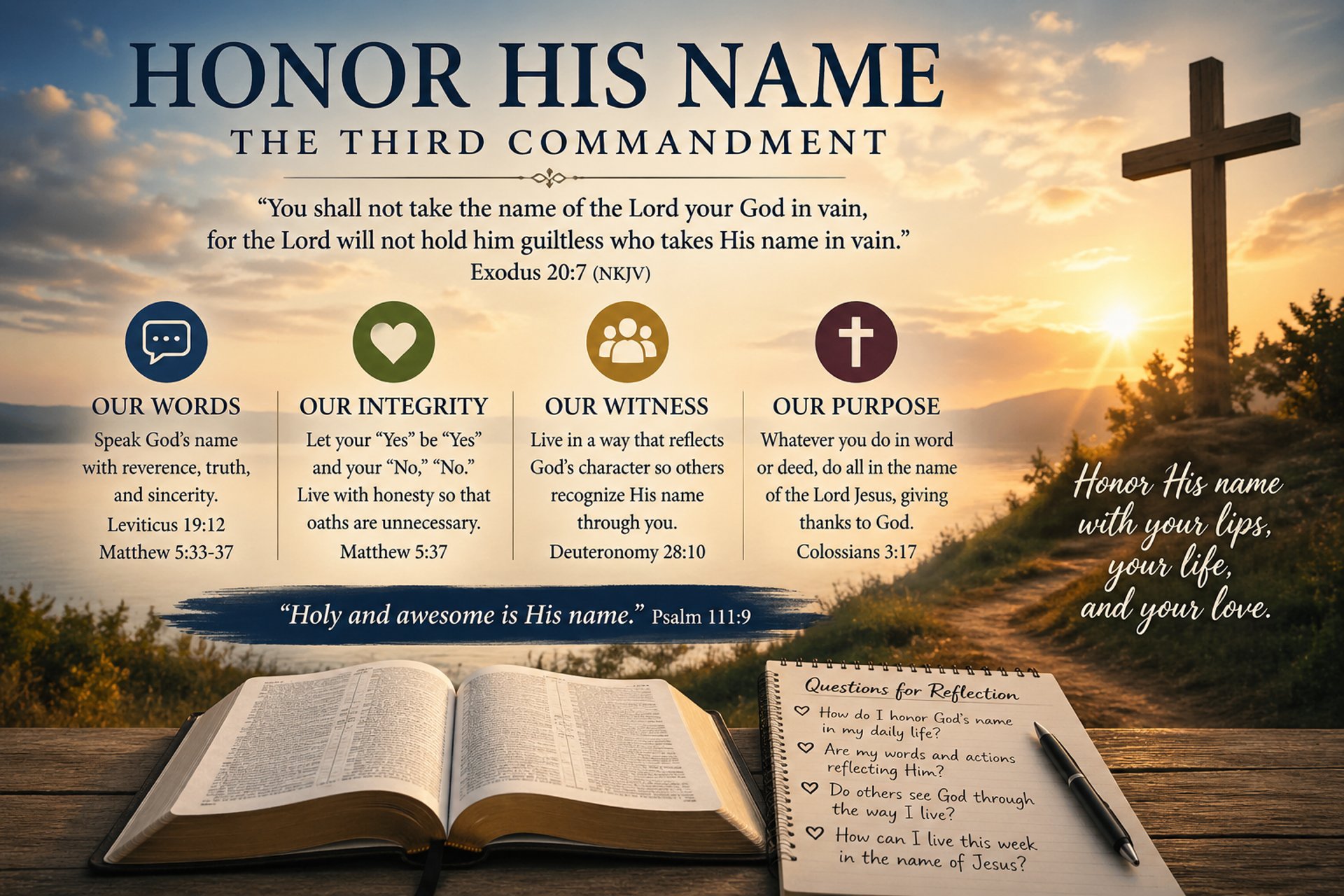
The Third Commandment in the Bible calls believers to treat God’s name with deep respect, sincerity, and honor—not just in what we say, but in how we live.
It is first given in Exodus 20:7 (NKJV):
“You shall not take the name of the Lord your God in vain, for the Lord will not hold him guiltless who takes His name in vain.”
In the Old Testament, God’s name represents His character, authority, and holiness. Misusing His name includes speaking it carelessly, making false promises in His name, or living in a way that misrepresents Him. Leviticus 19:12 warns:
“And you shall not swear by My name falsely, nor shall you profane the name of your God: I am the Lord.”
God’s people were meant to reflect Him so clearly that others would recognize His name through their lives (Deuteronomy 28:10). This shows that honoring God’s name goes beyond speech—it includes our witness and behavior.
In the New Testament, Jesus brings this commandment deeper into the heart. In Matthew 5:33–37, He teaches that truthfulness should be so consistent that oaths are unnecessary:
“But let your ‘Yes’ be ‘Yes,’ and your ‘No,’ ‘No.’ For whatever is more than these is from the evil one.”
This emphasizes integrity—our words should reflect truth because we belong to God. Likewise, Colossians 3:17 reminds believers:
“And whatever you do in word or deed, do all in the name of the Lord Jesus, giving thanks to God the Father through Him.”
The Third Commandment ultimately calls us to a life that honors God’s name in every area—our speech, our commitments, and our daily actions. His name is holy and worthy of reverence, as declared in Psalm 111:9.
Inspirational Questions for Reflection & Discussion
What does it truly mean to “honor” God’s name in everyday life—not just at church, but at home, school, or work?
Have there been times when my words didn’t reflect God’s truth or character? What can I learn from that?
How can I make sure my “yes” and “no” are honest and trustworthy like Jesus taught in Matthew 5:37?
In what ways do my actions represent God to others, whether I realize it or not?
How can I speak about God in a way that shows love, respect, and sincerity?
What practical steps can I take this week to live “in the name of the Lord Jesus” (Colossians 3:17)?
Why do you think God takes the use of His name so seriously?
How can remembering God’s holiness (Psalm 111:9) change the way I speak and live?
These questions can help guide both personal reflection and group discussion, encouraging a deeper understanding of what it means to honor God’s name with both our lips and our lives.