
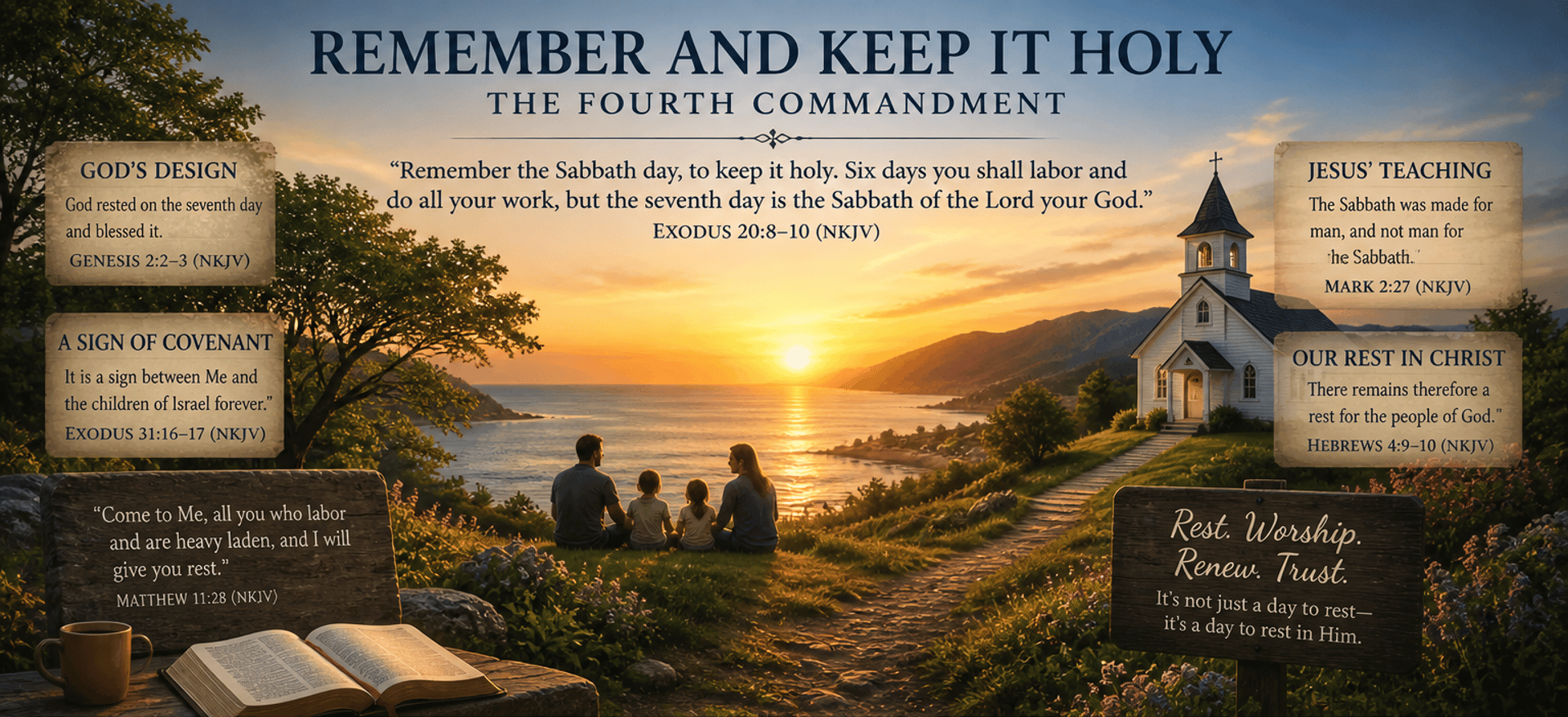
Remember the Sabbath: The Heart of the Fourth Commandment
By: Jennifer Sumrall
The Fourth Commandment in the Bible calls God’s people to remember the Sabbath and keep it holy—a day set apart for rest, worship, and trust in Him.
It is first given in Exodus 20:8–10 (NKJV):
“Remember the Sabbath day, to keep it holy… the seventh day is the Sabbath of the Lord your God.”
This command is rooted in creation. Genesis 2:2–3 teaches that God rested on the seventh day, blessing and sanctifying it. For Israel, the Sabbath (Saturday) became a covenant sign of their relationship with God (Exodus 31:16–17), reminding them that He is both Creator and Sustainer.
New Testament Fulfillment and Understanding
In the New Testament, Jesus emphasized the purpose behind the Sabbath rather than just the rule itself. In Mark 2:27, He said:
“The Sabbath was made for man, and not man for the Sabbath.”
He showed that the day was meant for restoration and doing good (Matthew 12:11–12), not legalistic restriction. The early church also began to focus on the deeper spiritual rest found in Christ. Hebrews 4:9–10 teaches that there remains a “rest” for God’s people—pointing to salvation and trust in Him.
By the time of Jesus, many religious leaders—often referred to as the Pharisees—had built a detailed system of rules around the Sabbath to make sure no one accidentally broke the Fourth Commandment. Their goal was to protect God’s law, but over time these added traditions became very strict and, at times, burdensome.
What was the problem?
The issue wasn’t that the leaders cared about God’s law—that part was good. The problem was:
They added human rules that went beyond what God commanded
They focused on external behavior instead of the heart
The Sabbath became heavy and restrictive, instead of restful and life-giving
Jesus challenged this approach. He showed that:
People matter more than rules
Doing good honors God, even on the Sabbath (Matthew 12:11–12)
The Sabbath should reflect mercy, rest, and relationship with God
The takeaway
The religious leaders turned the Sabbath into something people had to “get exactly right.”
Jesus restored it to what God intended:
a day meant to help people, not burden them.
So what should we do on the Sabbath (Saturday)?
Think of it in three simple directions: Rest, Worship, and Renewal
1. Rest from Regular Work
God established a rhythm—six days of work, one day of rest.
Step away from your normal job, chores, and daily grind
Avoid filling the day with stress or busyness
Trust that God provides, even when you pause
This reflects Genesis 2:2–3, where God rested—not because He was tired, but to set an example and bless the day.
👉 It’s less about “doing nothing” and more about stopping what usually consumes you
2. Spend Intentional Time with God
The Sabbath is meant to draw you closer to Him.
Read Scripture and reflect (not rushed)
Pray and talk with God honestly
Worship—personally or with others
Meditate on who God is and what He’s done
This connects with Leviticus 23:3, which describes the Sabbath as a “holy convocation” (a sacred gathering).
3. Do What Brings Spiritual and Inner Renewal
Jesus made it clear the Sabbath is about life, not restriction.
Spend meaningful time with family
Enjoy God’s creation (walks, quiet time outside)
Encourage or help someone
Do acts of kindness and mercy
Jesus said in Mark 2:27 that the Sabbath was made for man—so it should restore you, not drain you.
4. Focus on What Is Holy
“Keeping it holy” means setting the tone of the day apart.
Be mindful of your words and attitudes
Avoid things that pull your focus away from God
Create a peaceful, God-centered atmosphere
It’s not about a list of “don’ts”—it’s about intentionally honoring God with your time
A simple way to remember it:
👉 Stop – Rest – Worship – Connect – Renew
A balanced understanding
Some people today observe Saturday strictly as the Sabbath, while others worship on Sunday in honor of Jesus’ resurrection. But the deeper principle remains the same:
God desires that you regularly pause, rest, and reconnect with Him.
Historical Transition from Saturday to Sunday
The Bible consistently identifies the Sabbath as the seventh day (Saturday). However, after the resurrection of Jesus—which took place on the first day of the week (Sunday)—early Christians began gathering on Sundays to celebrate His resurrection.
We see hints of this shift in passages like:
Acts 20:7 – believers gathered on “the first day of the week” to break bread.
1 Corinthians 16:2 – offerings were set aside on the first day of the week.
By the 2nd and 3rd centuries, many Christians regularly met on Sunday, often called “the Lord’s Day” (Revelation 1:10). This was not presented as a direct replacement command in Scripture, but as a practice that developed to honor Christ’s resurrection.
Later, in 321 AD, Constantine the Great issued a civil decree making Sunday a day of rest in the Roman Empire. Over time, church tradition and cultural practice reinforced Sunday as the primary day of Christian worship.
Key Understanding
The original Sabbath (Saturday) remains clearly established in the Old Testament.
The New Testament emphasizes the spirit of rest, worship, and trust in Christ.
Sunday worship developed historically to honor Jesus’ resurrection, not by a single direct command changing the Sabbath.
Questions for Reflection & Self-Examination
Am I truly resting, or am I just staying busy with different kinds of work?
Have I intentionally set this day apart, or does it feel like every other day?
Did I make time to genuinely connect with God through prayer, reading, or worship?
Is my heart focused on God, or am I distracted by things that pull me away from Him?
Am I trusting God enough to pause from work and responsibilities, believing He will provide?
Did I create space for peace, quiet, and reflection, or fill the day with noise and activity?
Have I shown kindness, mercy, or love to others, as Jesus taught in passages like Matthew 12:11–12?
Am I treating the Sabbath like a gift, or like an obligation or burden?
Do my actions and choices today reflect that this day is holy and set apart?
Am I finding true renewal—physically, emotionally, and spiritually?
A deeper heart-check
If I observed the Sabbath, would I see rest, worship, and joy… or stress and routine?
These questions aren’t meant to make you feel pressured—they’re meant to gently guide you back to the purpose of the Sabbath:
👉 Resting in God, reconnecting with Him, and being renewed by His presence.
Bloodfallen's CB Corner
Bloodfallenscbcorner@gmail.com
© 2025. All rights reserved.


John 3:16 NKJV "For God so loved the world that He gave His only begotten Son, that whoever believes in Him should not perish but have everlasting life".
601-402-4128
Hattiesburg, MS 39402