
The Eighth Commandment: Living with Honesty in a World That Takes What Is Not Ours
The Eighth Commandment calls God’s people to a life of honesty, integrity, and trust. From the Book of Exodus to the teachings of Jesus Christ and the Apostle Paul, Scripture reveals that stealing is more than taking property—it is a matter of the heart. This devotional explores the meaning of “You shall not steal” in Hebrew and Greek, shows how God transforms dishonest hearts, and offers practical questions to help you walk in truth and generosity.
STUDYING THE TEN COMMANDMENTS
Jennifer
5/17/20263 min read
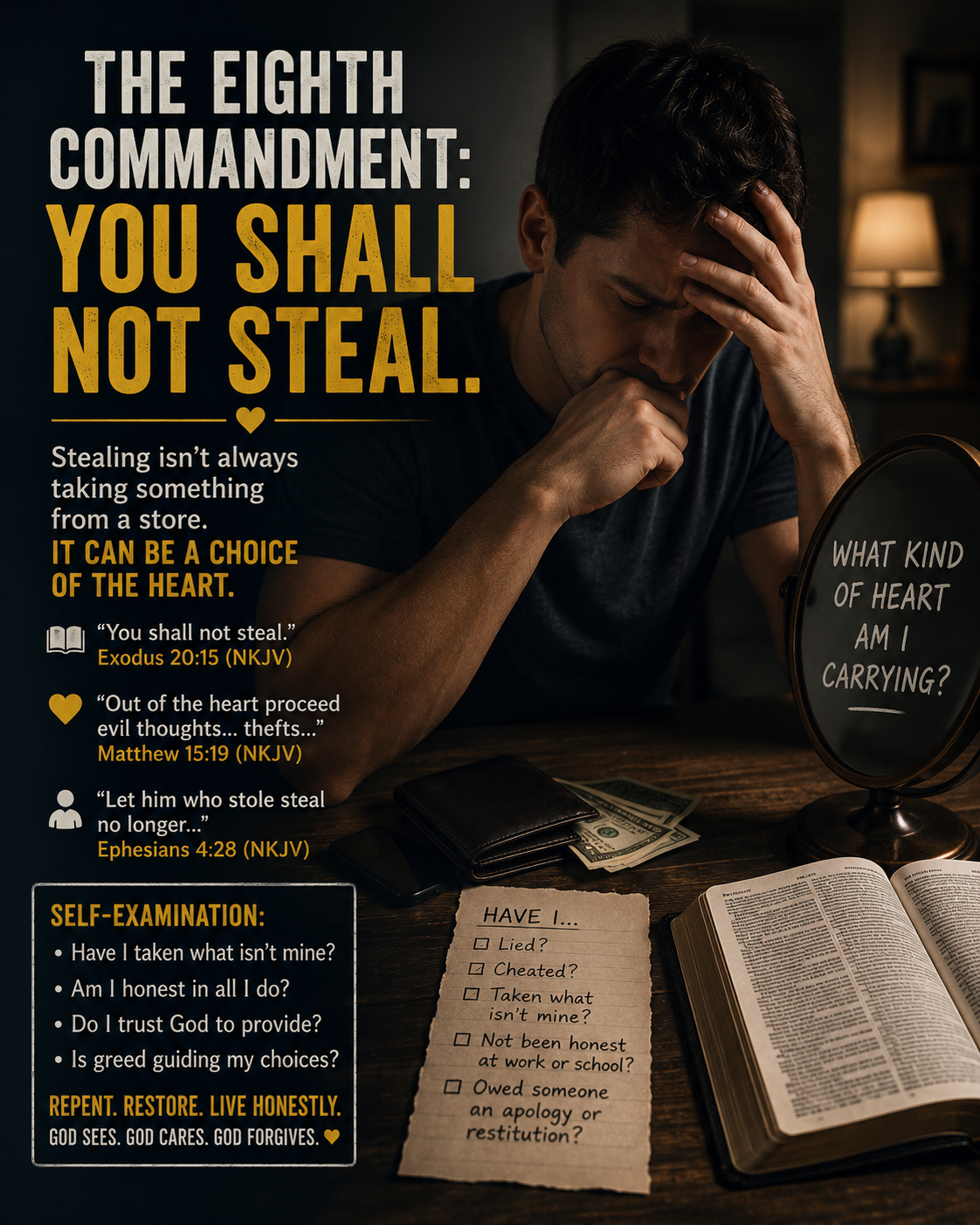
The Eighth Commandment: “You Shall Not Steal”
In the Book of Exodus, God gives a short but powerful command:
“You shall not steal.”
— Exodus 20:15 (NKJV)
The Hebrew word for “steal” is גָּנַב (ganab), meaning to take secretly, carry away, or obtain what belongs to another through deception or force. God’s command protects more than possessions; it protects trust, justice, and love within families and communities.
At its heart, the Eighth Commandment teaches us that God is the rightful Owner of everything, and we are called to be faithful stewards of what He has entrusted to us.
God Owns Everything
The Book of Psalms reminds us:
“The earth is the LORD’s, and all its fullness.”
— Psalm 24:1 (NKJV)
When we steal, cheat, or take what is not ours, we act as though God has not provided enough. Stealing often reveals a deeper issue—discontent, greed, or a lack of trust in God’s care.
Theft Can Take Many Forms
Most people think of stealing as burglary or robbery, but Scripture exposes many subtler forms:
Taking money or property that belongs to someone else
Cheating on taxes or financial obligations
Lying on business records
Keeping items that should be returned
Wasting time entrusted to us by employers
Plagiarizing another person’s work
Withholding fair wages
The Book of Malachi even asks:
“Will a man rob God?”
— Malachi 3:8 (NKJV)
God shows that dishonesty can also affect our relationship with Him.
Jesus and the Heart Behind Theft
Jesus Christ taught that sin begins in the heart:
“Out of the heart proceed evil thoughts... thefts...”
— Matthew 15:19 (NKJV)
The Greek word used for theft is κλοπή (klopē), meaning stealing or secret taking. Jesus reveals that theft is not merely an outward act; it springs from inward desires and attitudes.
The good news is that Christ transforms hearts. When He changes us, we no longer seek to take from others but to love and serve them.
A New Life of Honest Work
The Apostle Paul gives one of the clearest New Testament applications:
“Let him who stole steal no longer, but rather let him labor, working with his hands what is good, that he may have something to give him who has need.”
— Ephesians 4:28 (NKJV)
The Greek verb κλέπτω (kleptō) means “to steal.” Paul does more than say “stop stealing.” He calls believers to productive work and generous giving.
This is the gospel pattern:
Stop taking.
Start working honestly.
Begin giving generously.
Zacchaeus: A Changed Heart
In the Gospel of Luke, Zacchaeus demonstrated true repentance:
“If I have taken anything from anyone by false accusation, I restore fourfold.”
— Luke 19:8 (NKJV)
Salvation changed his relationship with money. He moved from greed to generosity and from dishonesty to restitution.
Integrity Pleases God
The Book of Proverbs teaches:
“Dishonest scales are an abomination to the LORD, but a just weight is His delight.”
— Proverbs 11:1 (NKJV)
God delights in truthful and fair dealings. Integrity honors Him even when no one else is watching.
The Positive Side of the Eighth Commandment
The Eighth Commandment is not merely a prohibition; it is an invitation to:
Trust God as Provider
Work honestly
Respect the property and efforts of others
Practice contentment
Give generously to those in need
Christ, Our True Treasure
When Jesus becomes our greatest treasure, we no longer need to grasp for what belongs to others. We learn contentment and joy in God’s provision.
“For where your treasure is, there your heart will be also.”
— Matthew 6:21 (NKJV)
Self-Examination Questions
Have I taken anything—money, property, credit, or time—that did not belong to me?
Am I fully honest in my work, business, and financial dealings?
Do I trust God to provide for my needs?
Is greed or discontent influencing my decisions?
Do I make restitution when I have wronged someone?
Am I using what God has given me to help others?
Is Jesus Christ my greatest treasure?
Closing Prayer
Lord, You are the Owner of all things and the faithful Provider of every good gift. Forgive me for any dishonesty, greed, or lack of trust in Your provision. Create in me a heart of integrity, contentment, and generosity. Help me to honor You with honest work and open hands. In Jesus’ name, Amen.
Bloodfallen's CB Corner
Bloodfallenscbcorner@gmail.com
© 2025. All rights reserved.


John 3:16 NKJV "For God so loved the world that He gave His only begotten Son, that whoever believes in Him should not perish but have everlasting life".
601-402-4128
Hattiesburg, MS 39402