
The Fifth Commandment: A Life of Honor Begins at Home
STUDYING THE TEN COMMANDMENTS
Jennifer Sumrall
5/5/20264 min read
The Fifth Commandment – Honor Your Parents
The fifth commandment says: “Honor your father and your mother” (Exodus 20:12, NKJV). This command teaches respect, obedience, and care for parents. It also carries a promise—that honoring them leads to well-being and a longer life.
In the Old Testament, this command was foundational for family and community order. For example, “Every one of you shall revere his mother and his father” (Leviticus 19:3, NKJV). It emphasizes not just outward obedience but a heart of respect.
In the New Testament, this command is reaffirmed and expanded. “Children, obey your parents in the Lord, for this is right. ‘Honor your father and mother,’ which is the first commandment with promise” (Ephesians 6:1–2, NKJV). Jesus also rebuked those who ignored this command (Mark 7:9–13), showing its ongoing importance.
Self-Examination Questions (within reflection on the passages):
When I read “Honor your father and your mother” (Exodus 20:12), do my words and actions reflect true respect at home?
In light of Leviticus 19:3, do I show reverence not just outwardly, but in my attitude?
As Ephesians 6:1 says, am I obeying “in the Lord,” with the right heart—not just doing what I’m told?
Considering Jesus’ warning in Mark 7:9–13, am I ever making excuses to avoid honoring my parents?
Do I show care, gratitude, and support for my parents as part of my daily life?
There is another post below that deals with how this can be hard with abusive parents.
The Fifth Commandment – Honor Your Parents
The fifth commandment says: “Honor your father and your mother” (Exodus 20:12, NKJV). This command teaches respect, obedience, and care for parents. It also carries a promise—that honoring them leads to well-being and a longer life.
In the Old Testament, this command was foundational for family and community order. For example, “Every one of you shall revere his mother and his father” (Leviticus 19:3, NKJV). It emphasizes not just outward obedience but a heart of respect.
In the New Testament, this command is reaffirmed and expanded. “Children, obey your parents in the Lord, for this is right. ‘Honor your father and mother,’ which is the first commandment with promise” (Ephesians 6:1–2, NKJV). Jesus also rebuked those who ignored this command (Mark 7:9–13), showing its ongoing importance.
Self-Examination Questions (within reflection on the passages):
When I read “Honor your father and your mother” (Exodus 20:12), do my words and actions reflect true respect at home?
In light of Leviticus 19:3, do I show reverence not just outwardly, but in my attitude?
As Ephesians 6:1 says, am I obeying “in the Lord,” with the right heart—not just doing what I’m told?
Considering Jesus’ warning in Mark 7:9–13, am I ever making excuses to avoid honoring my parents?
Do I show care, gratitude, and support for my parents as part of my daily life?
There is another post below that deals with how this can be hard with abusive parents.
The Fifth Commandment – Honor Your Parents
The fifth commandment says: “Honor your father and your mother” (Exodus 20:12, NKJV). This command teaches respect, obedience, and care for parents. It also carries a promise—that honoring them leads to well-being and a longer life.
In the Old Testament, this command was foundational for family and community order. For example, “Every one of you shall revere his mother and his father” (Leviticus 19:3, NKJV). It emphasizes not just outward obedience but a heart of respect.
In the New Testament, this command is reaffirmed and expanded. “Children, obey your parents in the Lord, for this is right. ‘Honor your father and mother,’ which is the first commandment with promise” (Ephesians 6:1–2, NKJV). Jesus also rebuked those who ignored this command (Mark 7:9–13), showing its ongoing importance.
Self-Examination Questions (within reflection on the passages):
When I read “Honor your father and your mother” (Exodus 20:12), do my words and actions reflect true respect at home?
In light of Leviticus 19:3, do I show reverence not just outwardly, but in my attitude?
As Ephesians 6:1 says, am I obeying “in the Lord,” with the right heart—not just doing what I’m told?
Considering Jesus’ warning in Mark 7:9–13, am I ever making excuses to avoid honoring my parents?
Do I show care, gratitude, and support for my parents as part of my daily life?
There is another post below that deals with how this can be hard with abusive parents.
The Fifth Commandment – Honor Your Parents
The fifth commandment says: “Honor your father and your mother” (Exodus 20:12, NKJV). This command teaches respect, obedience, and care for parents. It also carries a promise—that honoring them leads to well-being and a longer life.
In the Old Testament, this command was foundational for family and community order. For example, “Every one of you shall revere his mother and his father” (Leviticus 19:3, NKJV). It emphasizes not just outward obedience but a heart of respect.
In the New Testament, this command is reaffirmed and expanded. “Children, obey your parents in the Lord, for this is right. ‘Honor your father and mother,’ which is the first commandment with promise” (Ephesians 6:1–2, NKJV). Jesus also rebuked those who ignored this command (Mark 7:9–13), showing its ongoing importance.
Self-Examination Questions (within reflection on the passages):
When I read “Honor your father and your mother” (Exodus 20:12), do my words and actions reflect true respect at home?
In light of Leviticus 19:3, do I show reverence not just outwardly, but in my attitude?
As Ephesians 6:1 says, am I obeying “in the Lord,” with the right heart—not just doing what I’m told?
Considering Jesus’ warning in Mark 7:9–13, am I ever making excuses to avoid honoring my parents?
Do I show care, gratitude, and support for my parents as part of my daily life?
There is another post below that deals with how this can be hard with abusive parents.
The Fifth Commandment – Honor Your Parents
The fifth commandment says: “Honor your father and your mother” (Exodus 20:12, NKJV). This command teaches respect, obedience, and care for parents. It also carries a promise—that honoring them leads to well-being and a longer life.
In the Old Testament, this command was foundational for family and community order. For example, “Every one of you shall revere his mother and his father” (Leviticus 19:3, NKJV). It emphasizes not just outward obedience but a heart of respect.
In the New Testament, this command is reaffirmed and expanded. “Children, obey your parents in the Lord, for this is right. ‘Honor your father and mother,’ which is the first commandment with promise” (Ephesians 6:1–2, NKJV). Jesus also rebuked those who ignored this command (Mark 7:9–13), showing its ongoing importance.
Self-Examination Questions (within reflection on the passages):
When I read “Honor your father and your mother” (Exodus 20:12), do my words and actions reflect true respect at home?
In light of Leviticus 19:3, do I show reverence not just outwardly, but in my attitude?
As Ephesians 6:1 says, am I obeying “in the Lord,” with the right heart—not just doing what I’m told?
Considering Jesus’ warning in Mark 7:9–13, am I ever making excuses to avoid honoring my parents?
Do I show care, gratitude, and support for my parents as part of my daily life?
There is another post below that deals with how this can be hard with abusive parents.
The Fifth Commandment – Honor Your Parents
The fifth commandment says: “Honor your father and your mother” (Exodus 20:12, NKJV). This command teaches respect, obedience, and care for parents. It also carries a promise—that honoring them leads to well-being and a longer life.
In the Old Testament, this command was foundational for family and community order. For example, “Every one of you shall revere his mother and his father” (Leviticus 19:3, NKJV). It emphasizes not just outward obedience but a heart of respect.
In the New Testament, this command is reaffirmed and expanded. “Children, obey your parents in the Lord, for this is right. ‘Honor your father and mother,’ which is the first commandment with promise” (Ephesians 6:1–2, NKJV). Jesus also rebuked those who ignored this command (Mark 7:9–13), showing its ongoing importance.
Self-Examination Questions (within reflection on the passages):
When I read “Honor your father and your mother” (Exodus 20:12), do my words and actions reflect true respect at home?
In light of Leviticus 19:3, do I show reverence not just outwardly, but in my attitude?
As Ephesians 6:1 says, am I obeying “in the Lord,” with the right heart—not just doing what I’m told?
Considering Jesus’ warning in Mark 7:9–13, am I ever making excuses to avoid honoring my parents?
Do I show care, gratitude, and support for my parents as part of my daily life?
There is another post below that deals with how this can be hard with abusive parents.
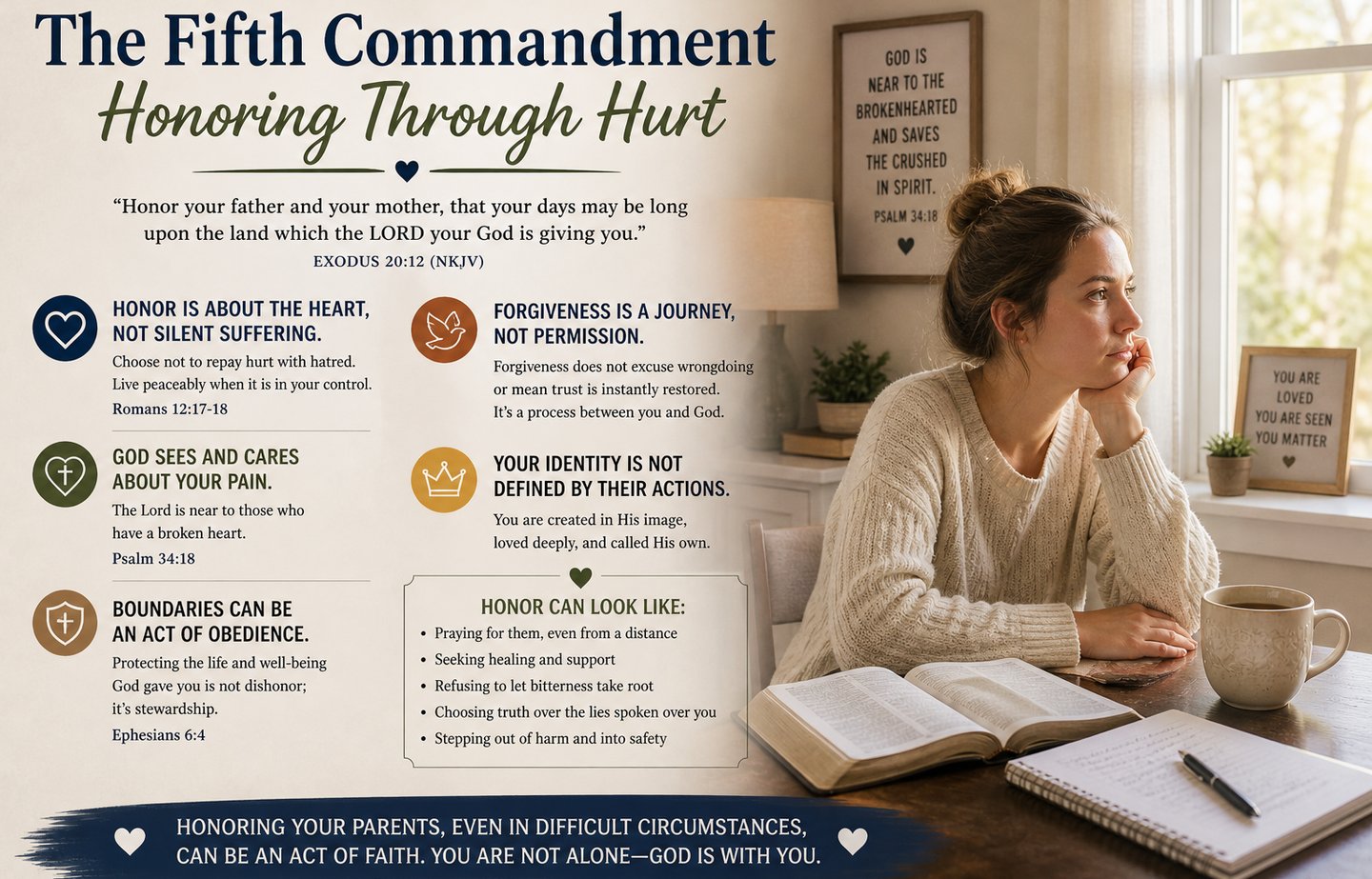

“Honor your father and your mother, that your days may be long upon the land which the LORD your God is giving you.” — Exodus 20:12 (NKJV)
The Fifth Commandment is a powerful call from God—a call to honor those who gave us life. At its best, this command reflects love, respect, and gratitude within the home. But for many, this command can feel complicated… even painful.
What happens when the home is not a place of encouragement, but of harsh words, emotional wounds, or even abuse?
From a spiritual perspective, we must approach this truth with both grace and clarity:
Honoring your parents does not mean accepting harm.
When Honor Feels Hard
Not every family reflects God’s design. Some experience words that cut deep, actions that wound, and patterns that leave lasting scars. If you’ve lived through this, it’s important to understand:
God does not call you to remain in situations that destroy your well-being.
Scripture shows us that God is not only a Father—He is a good Father:
“The Lord is gracious and full of compassion, slow to anger and great in mercy.” — Psalm 145:8
When earthly parents fall short—or fail completely—it does not change who God is.
What Does “Honor” Really Mean?
Honor is not blind obedience. It is not silent endurance of abuse. It is not pretending everything is okay when it isn’t.
Instead, honoring your parents can look like:
Choosing not to repay hurt with hatred
Refusing to let bitterness take root in your heart
Speaking truth with wisdom and restraint
Maintaining a posture of respect, even when creating distance
Scripture reminds us:
“Repay no one evil for evil… If it is possible, as much as depends on you, live peaceably with all men.” — Romans 12:17–18
Notice the wisdom here—“as much as depends on you.” Peace is not always possible, especially when harm is present.
God Sees Your Pain
If you’ve endured harsh words or abuse, know this: God sees you.
“The Lord is near to those who have a broken heart, and saves such as have a contrite spirit.” — Psalm 34:18
Your pain is not ignored. Your story matters. And your healing matters to Him.
Boundaries Are Not Disobedience
The Bible also places responsibility on parents:
“And you, fathers, do not provoke your children to wrath…” — Ephesians 6:4
This shows us something important—God’s design for family is not one-sided. Parents are called to nurture, not harm.
Setting boundaries, seeking help, or creating distance when necessary is not dishonor—it is wisdom. Protecting the life and peace God has given you is an act of stewardship.
Forgiveness Is a Process
Forgiveness is often part of honoring—but it’s important to understand what forgiveness is not:
It is not excusing wrongdoing
It is not forgetting what happened
Restoring trust is not an immediate
Forgiveness is a journey between you and God. It is choosing to release the weight of anger so it does not consume your heart.
Healing takes time—and that’s okay.
Your Identity Is Secure in Christ
The words spoken over you do not define you.
The actions done to you do not determine your worth.
Your identity comes from God alone. You are created in His image, deeply loved, and called His own.
What Honoring Can Look Like in Difficult Situations
When family relationships are broken, honoring your parents may look different than expected:
Praying for them, even from a distance
Seeking healing through God and wise counsel
Refusing to let hatred take control of your heart
Walking in truth rather than believing hurtful words
Choosing safety when necessary
Sometimes, honoring God means stepping out of harm and into healing.
Final Encouragement
The Fifth Commandment is not meant to trap you in pain—it is meant to guide you toward a life that reflects God’s heart.
And even when others fail you, God never will.
If this message speaks to your situation, consider reaching out to a trusted pastor, counselor, or support system. You are not meant to carry this alone.
“A life of honor begins at home—but healing begins with God.”
Bloodfallen's CB Corner
Bloodfallenscbcorner@gmail.com
© 2025. All rights reserved.


John 3:16 NKJV "For God so loved the world that He gave His only begotten Son, that whoever believes in Him should not perish but have everlasting life".
601-402-4128
Hattiesburg, MS 39402