
The Seventh Commandment: Guarding the Heart in Purity and Faithfulness
God’s command, “You shall not commit adultery,” reaches far beyond outward actions and into the hidden desires of the heart. This devotional explores the Hebrew and Greek meanings behind the seventh commandment and reveals how the Lord calls His people to sexual purity, covenant faithfulness, and holiness in thought and conduct. Through Scripture and honest self-examination, readers are encouraged to surrender lustful desires to God and walk in the transforming power of the Holy Spirit.
STUDYING THE TEN COMMANDMENTS
Jennifer Sumrall
5/10/20261 min read

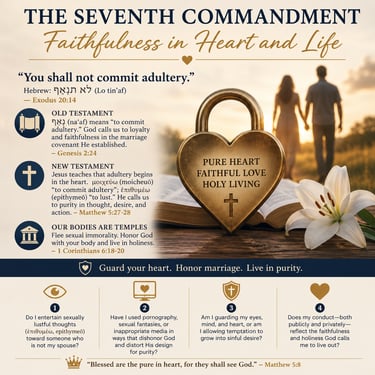
The Seventh Commandment: Faithfulness in Heart and Life
“You shall not commit adultery.” — Hebrew: לֹא תִּנְאָף (Lo tin'af, “You shall not commit adultery”) — Exodus 20:14
The seventh commandment calls God’s people to sexual purity, covenant faithfulness, and integrity in both marriage and thought. In the Old Testament, adultery was viewed as a serious violation of the marriage covenant established by God in Genesis 2:24. The Hebrew verb נָאַף (na'af, “to commit adultery”) describes unfaithfulness within marriage and reminds us that God values loyalty and holiness.
In the New Testament, Jesus Christ expands this command to include the inner life of the heart. He uses the Greek words μοιχεύω (moicheuō, “to commit adultery”) and ἐπιθυμέω (epithymeō, “to lust or strongly desire”) when teaching that anyone who looks at another person with lustful intent has already committed adultery in the heart (Matthew 5:27–28). God’s standard is not only outward faithfulness but inward purity. Believers are called to flee sexual immorality and honor God with their bodies, which are temples of the Holy Spirit (1 Corinthians 6:18–20).
The seventh commandment reveals God’s desire for His people to reflect His faithful love in both relationships and private thoughts. Through His grace, He can cleanse the heart and empower us to walk in holiness.
Spiritual Self-Examination Questions
Do I treat marriage as a holy covenant established by God?
Have I used pornography, sexual fantasies, or inappropriate media that dishonor God and distort His design for purity?
Am I guarding my eyes, mind, and heart, or am I allowing temptation to grow into sinful desire?
Does my conduct—both publicly and privately—reflect the holiness God calls me to live out?
Does my life reflect the faithfulness and purity that God shows toward His people with love and compassion, not with a strong desire(ἐπιθυμέω, epithymeō) for someone either in-person or from entertainment that is not my spouse?
Bloodfallen's CB Corner
Bloodfallenscbcorner@gmail.com
© 2025. All rights reserved.


John 3:16 NKJV "For God so loved the world that He gave His only begotten Son, that whoever believes in Him should not perish but have everlasting life".
601-402-4128
Hattiesburg, MS 39402